

Our own product implementation - Connecting guides, generated references, and AI search for Biel.ai
Biel.ai brings guides, an OpenAPI-generated reference, and AI chat and search into a Docusaurus documentation site with automated publishing. Biel.ai is a product built and operated by TechDocs Studio.
- Our product
- Biel.ai
- Year
- Service
- Documentation platform engineering
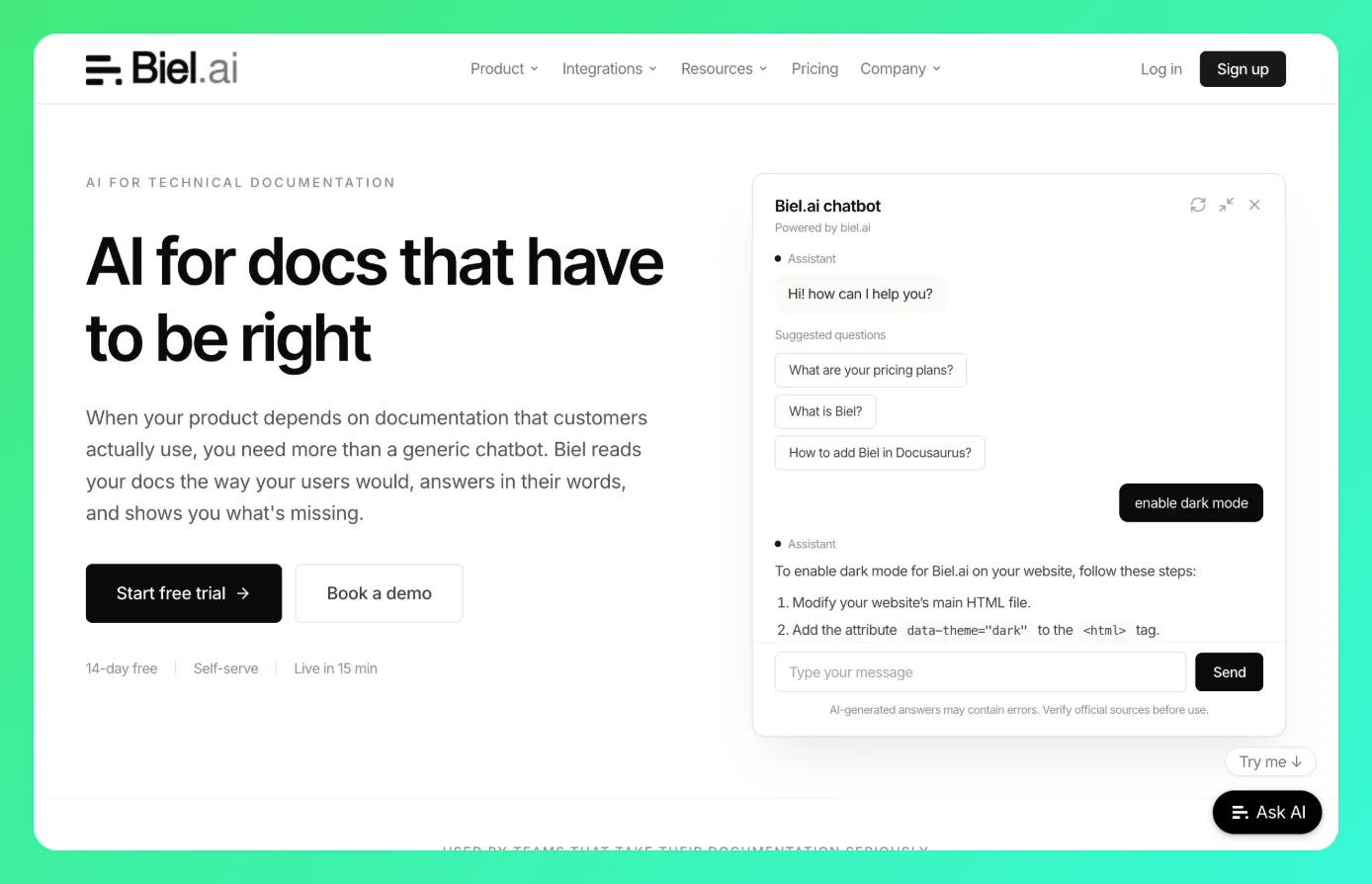
Guides, references, and answers in one place
Biel.ai adds AI chat and search to documentation sites. Its readers need to set up integrations, customize the assistant, and work with the REST API. The documentation brings those tasks together in a site that the team can update through Git.
Biel.ai is built and operated by TechDocs Studio. Try the documentation, generated reference, and assistant at docs.biel.ai.
A modern Docs-as-Code documentation site
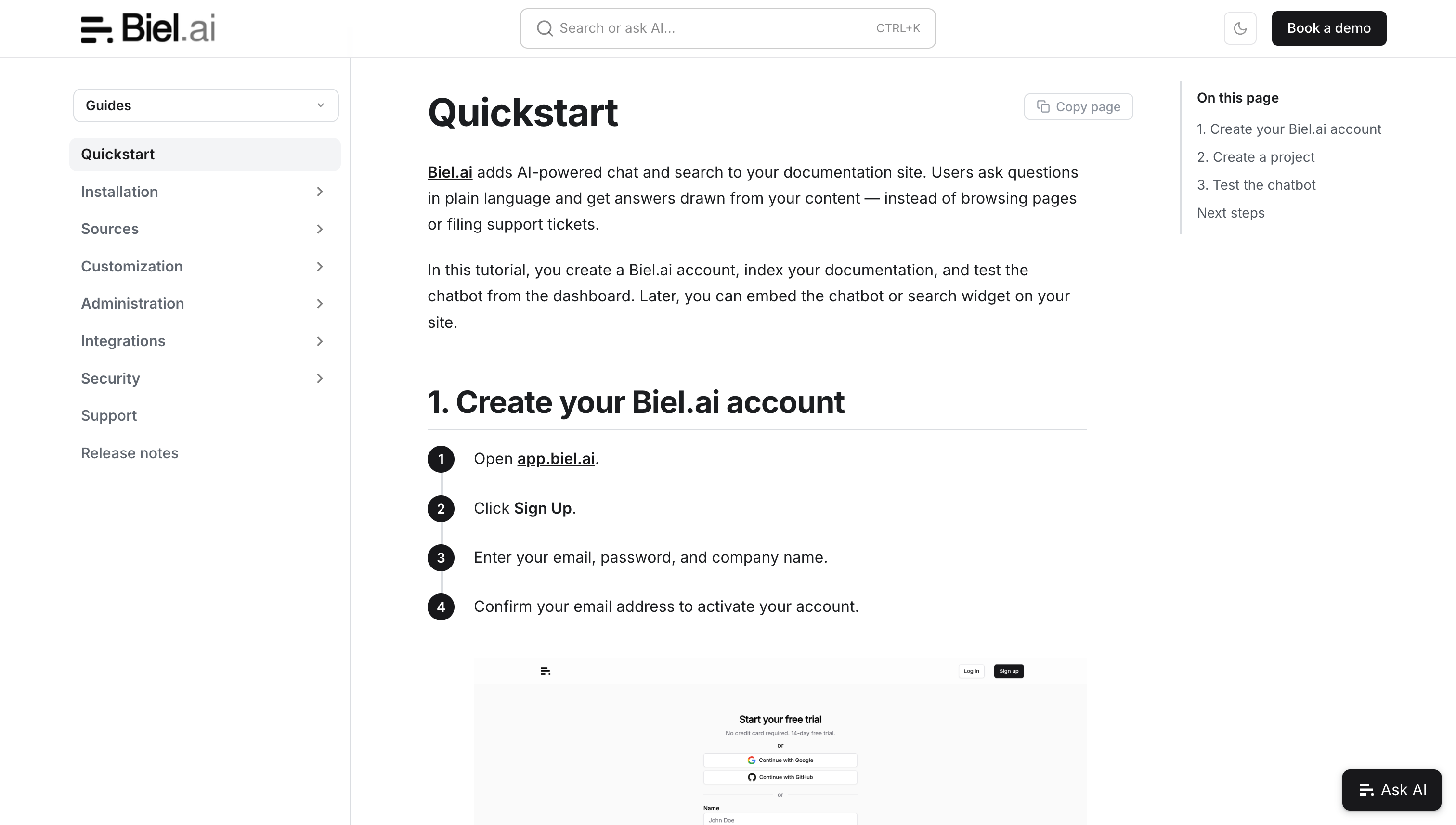
The documentation runs on a customized Docusaurus site:
- Docs-as-Code workflow: content lives in Git as Markdown, is reviewed like code, and is built and deployed automatically on every change.
- Custom theme and layout: aligned with the Biel.ai brand, with fast navigation and a clean reading experience across guides, customization, administration, and integrations.
- AI search and Ask AI built in: the same product powers its own docs, readers can ask questions through the "Search or ask AI" bar and the Ask AI assistant.
An API reference that stays in sync
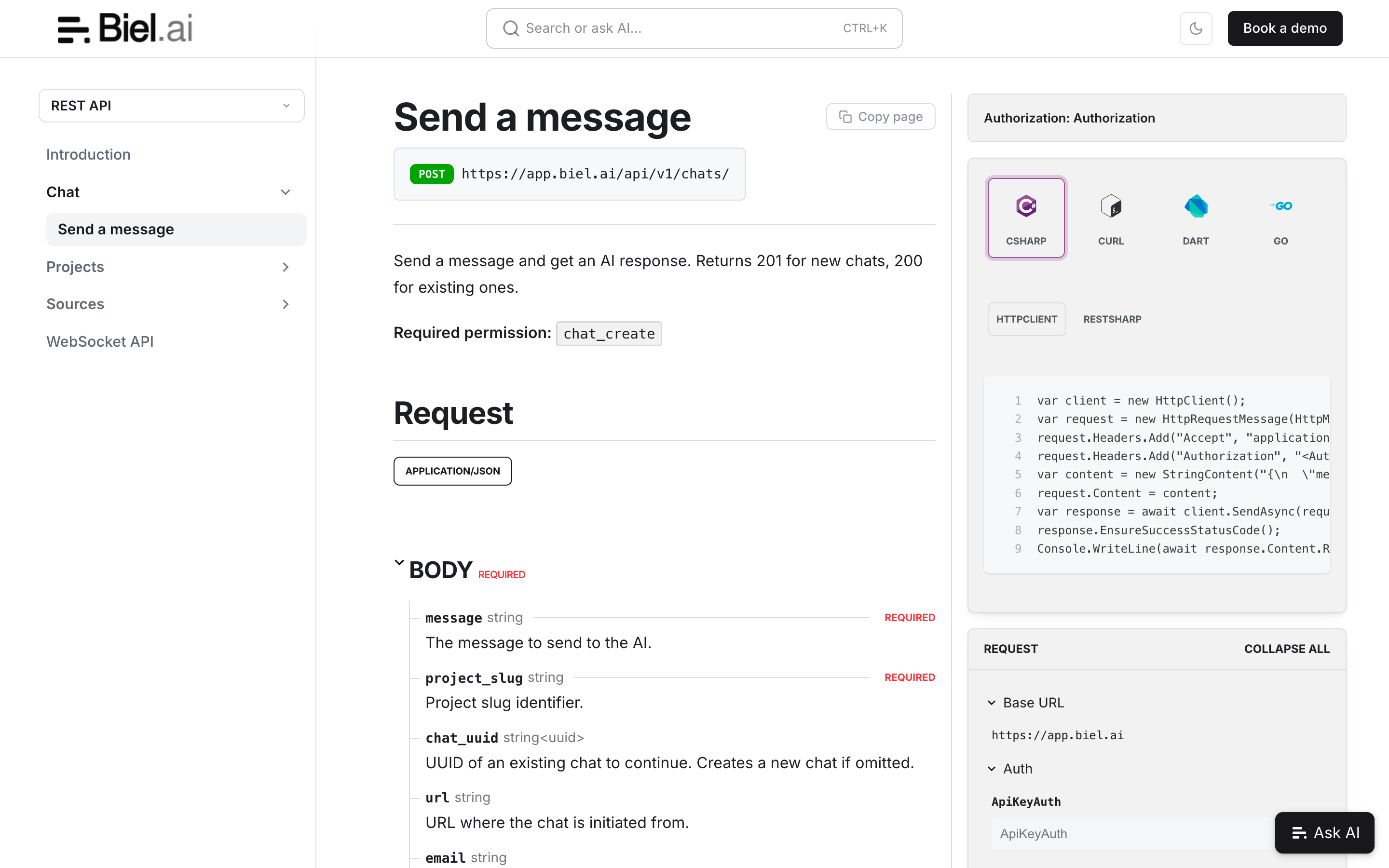
The REST API reference is generated from an OpenAPI specification rather than maintained as a separate set of handwritten pages. Keeping the specification accurate remains part of maintaining the API:
- Generated from a single source: endpoints, parameters, and schemas come straight from the spec.
- Multi-language code samples: every endpoint ships ready-to-run examples (cURL, C#, Dart, Go, and more).
- Request/response detail: auth, required permissions, and full body schemas, laid out for developers to copy and go.
Updating the specification rebuilds the reference through the publishing workflow, reducing the number of places the team has to maintain endpoint details.
AI-ready by construction
The site gives readers and retrieval tools access to the same source content:
- Crawlable, standalone pages that both humans and AI retrieval systems can consume.
- An automatically maintained
llms.txtgiving AI tools a structured map of the documentation. - Content written around real user questions, to give readers and retrieval tools relevant source context.
The result, on our own docs: the assistant handles around 155 conversations a month, while we answer fewer than ten support emails it didn’t cover.
Support questions help the team identify missing explanations and improve the source documentation. Those updates are then available to readers and the assistant; answer quality still needs evaluation.
A workflow your team can build on
The implementation connects the main parts of the documentation workflow:
- Docs-as-Code, version-controlled, automatically built and deployed.
- AI access, structured source content with chat and search built in.
- API reference automation, generated from the maintained OpenAPI specification.
- Ongoing maintenance, reviewed content and specification changes feed into automated publishing.
See it for yourself: it's all running on Biel.ai's own docs at docs.biel.ai.
Tech stack
- Docusaurus
- Docs-as-Code
- OpenAPI
- llms.txt
- AI search & chat
- GitHub Actions